
Caribbean Futures
AI mood boards and robotic archwire bending for Carnival costumes
The archwire-bending brand identity of the Trinidad Carnival has penetrated markets in the Middle East. In Dubai, the world witnessed a quiet handover from craft to machine.
Trinidad Carnival sits at a strange intersection. Its costume-making tradition is the most embodied art in the region — wire bent by hand, feathers stitched into mood, sequins applied with the patience of liturgy. And yet the tools that shape the next generation of those costumes are increasingly statistical. The mas camp, once a room full of bent backs and bent rods, is becoming a room full of screens.
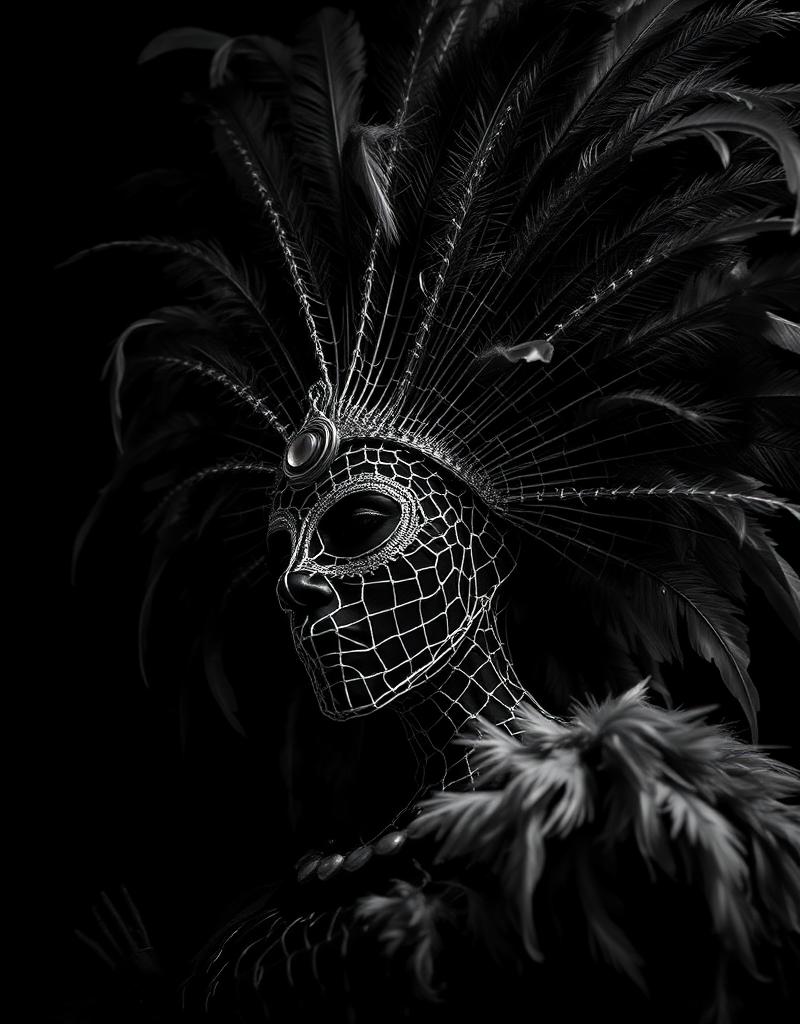
In Dubai earlier this year, a quietly historic thing happened. A masquerade band founded in Port of Spain delivered a full Carnival presentation whose silhouettes were generated, iterated, and finally cut by a machine. The mood boards came from a fine-tuned diffusion model trained on three decades of Carnival photographs. The archwires — the structural skeletons that give a costume its lift — were bent by a six-axis robot calibrated to a tolerance the human wrist cannot match.
Nothing about the result felt cold. The costumes still pulsed on the road. The feathers still caught the light. But the labour underneath had changed shape. The designer who used to bend a hundred wires in a week now reviewed a hundred wires bent in an hour, and spent the saved time on the parts of the costume the machine could not yet imagine: the negotiation with the wearer's body, the choreography with the music truck, the relationship to the route.
AI mood boards generate the colour grammar long before a single rod is cut. They compress what used to be a season of sketching into an afternoon of selection. The designer becomes a curator of possibility rather than a generator of it. This is not a small change. It alters what counts as authorship, what counts as labour, and what counts as a Carnival costume.
Robotic archwire benders execute the silhouette with a tolerance the wrist cannot match. They also execute it without fatigue, without injury, and without the slow accumulation of tacit knowledge that used to be the wirebender's only pension. A craft that took twenty years to learn can now be approximated by a machine in twenty seconds. The question of what we owe the wirebender is not a sentimental question. It is an economic one.
The carnival has not been displaced. It has been re-mediated. What survives is the West Indian choreography of design — the call-and-response between maker, machine, and crowd. What changes is the speed at which that choreography compounds. A band that used to release one presentation a year can now prototype a dozen. The bottleneck is no longer production. It is taste.
And taste, in the Carnival tradition, is communal. It is debated in the panyard, on the corner, in the comments under a Facebook video. The danger of statistical tooling is that it can flatten that debate into a single optimised aesthetic — the costume that scores highest against last year's likes. The opportunity is the opposite: that the same tools can let a band test ten radical departures in the time it used to test one safe iteration, and let the crowd vote with its feet.
Dubai mattered because it proved the export. The archwire-bending brand identity of the Trinidad Carnival has penetrated markets in the Middle East not as nostalgia but as infrastructure. Other festivals, other diasporas, other climates are buying the toolchain. The Caribbean has spent five hundred years exporting its labour. It is finally beginning to export its methods.
— Fazal Ali · 30 May 2026 —
Next entry · Education
Failure as essential in the age of AI
The future we are in now belongs to our children. Our fears can become a cage that makes them doubt the very faculty AI most rewards: the willingness to be wrong out loud.